
United States Disposal Service provides 4-yard front-load dumpster service for San Antonio businesses that have outgrown a cart or a 2-yard: the Tex-Mex restaurant off Broadway, the medical office near the South Texas Medical Center, the strip center on Bandera Road, the small apartment property in Alamo Heights. The company describes the 4-yard as a fit for medium-sized restaurants and businesses with 25 to 100 employees. Trash collection and recycling collection are both included in the rental agreement. Weekly pickup is the starting point, and each account is quoted for its own address. This guide covers what the City of San Antonio does and doesn’t collect, the permit every commercial hauling truck needs, where the fire code lets the box sit, the city’s apartment recycling rule, and the grease and storm drain rules that matter most to restaurants.
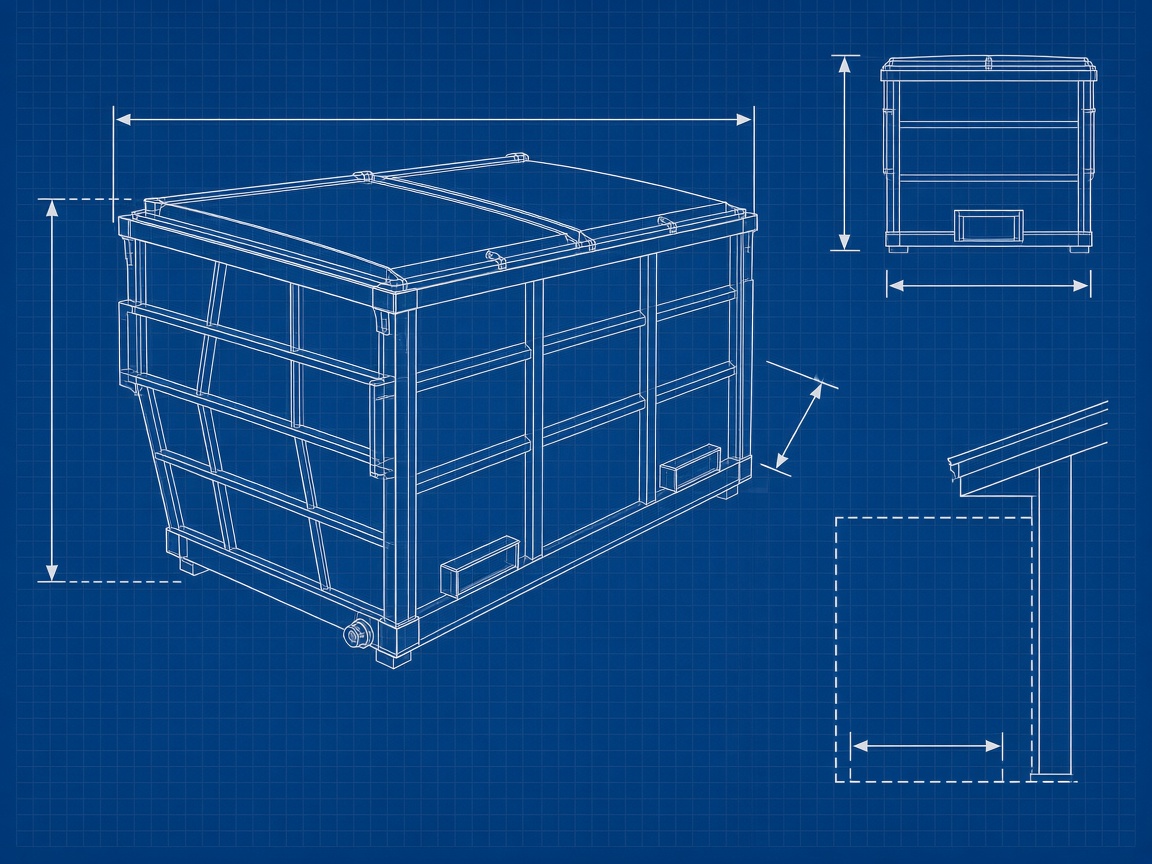
The City of San Antonio does not provide commercial dumpsters
San Antonio’s Solid Waste Management Department (SWMD) runs automated cart collection for traditional single-family homes. Its Information Bulletin 576, written with Development Services, says plainly that the City does not provide commercial dumpsters, does not collect from multi-family developments such as apartments and high-rise residential buildings, and does not provide service in the Central Business District.
There is a narrow exception. Under City Code Chapter 14, Section 14-20, a small business whose waste is similar in content and volume to a household’s can ask for City cart service, capped at five container sets per business, and only where the stop fits an existing route. A restaurant, a medical office with a full waiting room, or a retail center filling a 4-yard every week is well past that profile. Those properties hire a private hauler, and that is the service United States Disposal Service arranges.
Every truck that empties your box needs a City permit
San Antonio does not grant an exclusive commercial franchise, so a business can choose its provider. What the City regulates is the truck. Its Private Haulers page says anyone hauling commercial solid waste anywhere in the city needs a Commercial Solid Waste Hauler Vehicle Permit, and that Article IV of Chapter 14 sets the operating rules. The page lists these details:
- An annual permit fee of $150 for vehicles of 6,999 pounds GVW or less and $2,250 for vehicles of 7,000 pounds or more. A front-load truck falls in the second group.
- Proof of $500,000 combined single limit liability insurance for each permitted vehicle of 7,000 pounds or more.
- Quarterly installments due February 1, May 1, August 1 and November 1, with no proration, and a permit that runs twelve months from issue.
- A vehicle list filed with SWMD, possible vehicle inspections, and a public list of permitted companies.
The City Code calls it a public nuisance to collect, or offer to collect, solid waste inside the city limits without a current permit decal on each vehicle. United States Disposal Service is based in Jacksonville, Florida, and arranges service in San Antonio through trusted local contractors who run the trucks. Where a city permit applies, the company works with licensed, permitted local haulers. You can always ask to see the permit decal on the truck that services your property.
Where a 4-yard can sit under the San Antonio Fire Code
San Antonio has adopted the 2024 International Fire Code with local amendments. In the San Antonio Fire Code 2024 text, Section 304.3.5 says dumpsters and containers with an individual capacity of 1.5 cubic yards or more may not be stored in buildings or placed within 5 feet of combustible walls, openings or combustible roof eave lines. Section 304.3.3 adds that containers larger than 40 gallons need lids.
A 4-yard is well over that line. In practice:
- Keep the box at least 5 feet from wood fences, siding, stucco over wood framing and shingle eaves.
- Don’t place it in front of a back door, a window or an exhaust vent, even “just for the weekend.”
- Don’t roll it into a loading dock bay or a back hallway to keep it out of the sun.
The code’s exceptions cover sprinkler-protected areas and a dedicated Type I or IIA container structure set at least 10 feet from other buildings. Whether your site qualifies is a question for the San Antonio Fire Department’s fire marshal. Ask before you pour a new pad or move an enclosure.
Plan the pad and the approach before the first delivery
A front-load truck drives straight at the box, picks it up on its forks and lifts it overhead. When the company quotes a 4-yard, it asks about the approach, the overhead clearance (wires, tree limbs, canopies and balconies), the width of the enclosure and whether the gates swing fully open. An older strip center with a tight rear lot and a newer center with landscaped islands and low canopies can need very different box placements. Mark where cars should not park on pickup day, and keep the enclosure gates unlocked or tell the company how the driver gets in.
Texas law also sets a floor for how often the box is emptied. IB 576 points to TCEQ rules in 30 TAC Chapter 330, which require garbage containing putrescible material, such as food waste, to be collected at least once a week. Every United States Disposal Service front-load account starts at weekly pickup. Collection can go to two, three or four days a week or daily, and can be scaled back during a seasonal slowdown, such as a school-year office or a summer-heavy River Walk supplier.
Apartments and condos: San Antonio’s multi-family recycling rule
On December 9, 2010, City Council passed an ordinance requiring all multi-family properties to provide recycling service to their occupants. The City’s Multi-Family Recycling page says SWMD staff inspect properties for compliance, and its service requirements page spells out what the recycling has to look like:
- Signs on every recycling container saying it is for recyclables and listing what’s accepted.
- Recycling containers of similar size, or similar capacity, as the trash containers.
- A recycling container next to or close to every trash container, with collection as convenient as garbage collection.
- No overflow, and residents told what’s accepted and about any change in service.
Recycling collectors that serve multi-family properties, and owners who self-haul, file an annual report by March 1 with units served, tons collected and the facilities used. For a property with one 4-yard trash box, the usual way to meet the “similar capacity, close by” standard is a second front-load container for recycling in the same enclosure. United States Disposal Service includes recycling collection in the rental agreement and confirms what local facilities accept when it quotes the property. See the company’s property manager and commercial recycling pages for more.
Restaurants: grease stays out of the dumpster
The 4-yard is the box most often matched to a busy San Antonio restaurant, and two local rules shape how it is used. The first is the fats, oils and grease ordinance, Ordinance 2011-05-12-0378, which added a FOG division to City Code Chapter 34. San Antonio Water System (SAWS) runs it through its Fats, Oils & Grease Abatement Program. Food service and food processing establishments in the city and its extraterritorial jurisdiction must send grease-bearing drains through a maintained interceptor. The interceptor must be pumped at least every 90 days, and within two working days once 25 percent of its wetted height is grease or solids. Pumped grease may go only to a facility authorized to receive it.
The second is the City’s storm water guidance for businesses. Its Remember the River best practices say never to put chemical liquids, fats, oils or grease in the dumpster. The same page says to bag trash, keep lids closed and secure, keep the area around the box clean, and avoid overfilling. It also says not to hose out a dumpster’s interior; ask your hauler to swap a soiled box for a clean one. When the truck services a permanent United States Disposal Service dumpster, the trash is removed and the unit is cleaned. Ask about a container exchange if odor becomes a problem in a Texas summer.
The company’s restaurant dumpster service page covers the rest of the kitchen side, and the medical and dental page explains why regulated medical waste never goes in a front-load box.
Is a 4-yard the right size?
Headcount is only a starting point. The better test is how your current container behaves. If a 2-yard is overflowing before pickup, or you are paying for extra pickups every week, a 4-yard on the same schedule is the usual next step. If a 4-yard is full in three days because of flattened boxes, a second box for cardboard often solves it more cheaply than a larger trash box. If you are filling a 4-yard twice a week and the enclosure has room, compare that with a 6-yard. Elsewhere in Texas, see the company’s Houston 2-yard guide.
Frequently asked questions
1. Will the City of San Antonio empty a dumpster at my business?
No. SWMD Information Bulletin 576 says the City does not provide commercial dumpsters and does not serve the Central Business District. Limited City cart service is available only to small businesses whose waste is similar to a household’s, up to five container sets.
2. Does San Antonio have an exclusive commercial trash franchise?
No exclusive commercial franchise is listed by the City. Instead, every vehicle that collects or hauls commercial solid waste in the city needs a Commercial Solid Waste Hauler Vehicle Permit under Chapter 14, Article IV.
3. What does the hauler permit cost?
The City lists $150 a year for vehicles of 6,999 pounds GVW or less and $2,250 a year for vehicles of 7,000 pounds or more, paid in quarterly installments. Heavier vehicles also need $500,000 in liability coverage. The hauler pays this, not the business.
4. How close to my building can a 4-yard sit?
Under Section 304.3.5 of the San Antonio Fire Code (2024 IFC as adopted), a container of 1.5 cubic yards or more may not be stored inside or within 5 feet of combustible walls, openings or roof eave lines, unless an exception such as sprinkler protection applies. The fire marshal has the final word.
5. How often must a restaurant dumpster be emptied in Texas?
TCEQ rules in 30 TAC Chapter 330 require garbage containing putrescible material to be collected at least once a week. United States Disposal Service starts every front-load account at weekly pickup and can add days.
6. Do San Antonio apartments have to recycle?
Yes. A 2010 City ordinance requires multi-family properties to provide recycling to residents, with signed containers of similar capacity placed next to or close to the trash containers, and SWMD inspects for compliance.
7. Can used fryer grease go in the dumpster?
No. The City’s storm water guidance says never to put fats, oils or grease in a dumpster, and the SAWS FOG ordinance requires grease interceptors to be pumped at least every 90 days, with the waste taken to an authorized facility.
8. Can I add a recycling container next to the 4-yard?
Yes. A container used only for recyclable material can be added, and recycling collection is included in the rental agreement. What’s accepted locally is confirmed when the company quotes your property.
9. How do I get a quote for a 4-yard front-load dumpster in San Antonio?
Email [email protected] or call 904-305-7534 with the service address, business type, what you throw away, how often your current container fills, your recycling setup and where the box will sit. You can also start at Order Now.
Follow United States Disposal Service on LinkedIn for service updates, and see more posts in the Newsroom.