
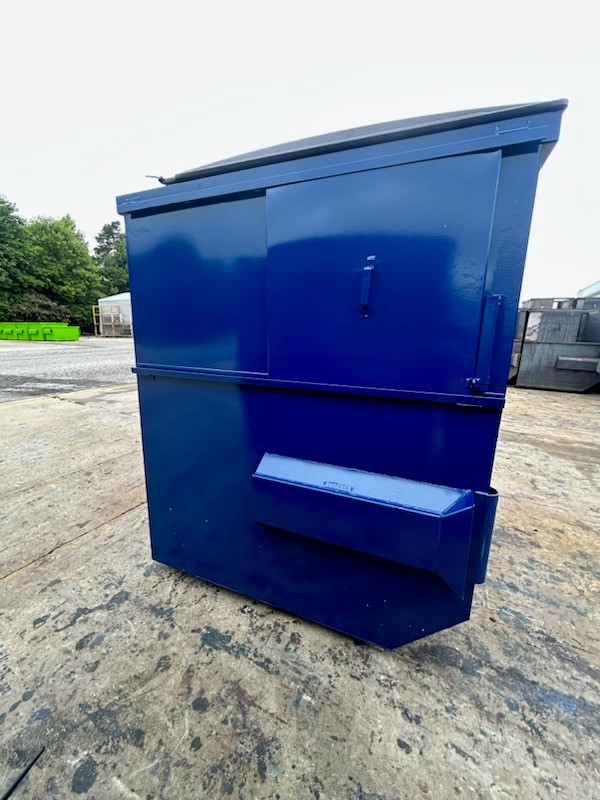
United States Disposal Service provides 2-yard front-load dumpster service for small Ohio businesses: the coffee shop in a Columbus neighborhood, the corner pizza place in Toledo, the two-chair dental office outside Dayton, the insurance agency on a Cincinnati side street. The 2-yard is the smallest front-load container the company lists. Trash collection and recycling collection are both included in the rental agreement, weekly pickup is the starting point, and each account is quoted for its own address. Owners often assume a small box comes with small rules. In Ohio it does not. This guide starts with the state fire and food rules that decide where even a 2-yard can sit, then covers county solid waste districts, the hauler rules in Columbus, Cleveland and Cincinnati, and what Ohio law keeps out of the trash.
Why a 2-yard still counts under the Ohio Fire Code
Ohio’s fire code lives in the Ohio Administrative Code. Rule 1301:7-7-03 adopts Chapter 3 of the 2021 International Fire Code with Ohio modifications, and those modifications leave the dumpster section as written. That section, 304.3.3 in the 2025 Ohio Fire Code published by the International Code Council, says dumpsters and containers with an individual capacity of 1.5 cubic yards or more may not be stored in buildings or placed within 5 feet of combustible walls, openings or combustible roof eave lines.
A 2-yard is over that 1.5-cubic-yard line, so the smallest box on the menu follows the same clearance rule as an 8-yard. Do not tuck it against vinyl siding or under a wood or shingle eave, park it in front of a door, window or vent, or store it in a back hallway because it is “only a 2-yard.” The listed exceptions cover sprinkler-protected areas and a dedicated Type I or IIA container structure at least 10 feet from other buildings. Whether your building qualifies is a question for your local fire official. Ask before you pour a new pad or move the box closer to the back door.
Restaurants and food stores: the Ohio food code
The 2-yard is the box most often matched to a small restaurant, and Ohio Administrative Code 3717-1-05.4 (refuse, recyclables and returnables, effective September 5, 2024) is specific about outdoor refuse at food service operations and retail food establishments:
- Pad: nonabsorbent material such as concrete or asphalt, smooth, durable and sloped to drain. Gravel or grass does not qualify.
- Lid: outside receptacles for materials with food residue need tight-fitting lids, doors or covers, and must be kept covered. The USDS container comes with a lid; keeping it shut is on the staff.
- Drain plugs: drains in refuse receptacles must have their plugs in place.
- Enclosure: if used, durable and cleanable, in good repair, and kept clean and free of unnecessary items.
- Capacity and frequency: enough room for what accumulates, and removal often enough to minimize odors, insects and rodents.
- Cardboard: packaging without food residue that is awaiting a regularly scheduled recycling or disposal pickup may sit outside uncovered if it does not create a rodent harborage problem. Unprotected bags with food residue may not be stored outside.
Those last two points are where a 2-yard can get a small kitchen in trouble. If the box is full two days before pickup and bags start lining up beside it, the fix is a second weekly pickup, a separate cardboard container, or a step up to a 4-yard.
Who a 2-yard front-load dumpster fits
The company’s front-load lineup is four sizes: 2, 4, 6 and 8 yards, with no off-menu sizes. The Commercial Dumpster Rentals page describes the 2-yard as the container for a small restaurant or a company with only a handful of people on staff. The industry pages name a café or takeout window (Restaurant Dumpster Service), a small professional office (Office Dumpster Service), a small dental or single-physician practice for ordinary office trash, not regulated medical waste (Medical and Dental Dumpster Service), a light-traffic boutique (Retail and Strip Center Dumpster Service), a small independent garage (Auto Shop Dumpster Service) and a parish office with a light Sunday kitchen (Church and School Dumpster Service).
Headcount is only a starting point. It is more useful to say how often your current container is already full and whether the load is mostly dry cardboard, wet food waste or a mix. A Lakewood bookshop and an Akron taco counter may each have four employees, but one throws out flattened boxes and the other wet, heavy food waste.
What comes with the rental
The container comes with a lid, which helps keep rain, animals and odor in check. Every commercial dumpster rental includes weekly collection. Pickup can go to two, three or four days a week, and daily collection is available. Frequency can also be reduced for a seasonal slowdown, such as a summer-only ice cream stand near Lake Erie, with billing updated to match. On a permanent account the container stays on the property, and when the truck services it the trash is removed and the unit is cleaned. A second container used only for recyclable material can be added (Commercial Recycling); accepted materials are confirmed for your address when quoting.
Before you choose a 2-yard
- Count how many times last month the current container was full before pickup day.
- If it fills with cardboard, a recycling container may fix it without a bigger trash box. If it fills with food waste, consider a second weekly pickup first; a small box emptied twice a week smells less than a big one emptied once.
- Measure the spot. The truck approaches from the front, engages and lifts the box, and returns it to the same place, so approach, overhead clearance, enclosure width and gate access all matter, along with the 5-foot fire code clearance.
- Plan for winter. Keep plowed snow off the approach so the truck can line up.
Ohio’s solid waste management districts
Under Ohio Revised Code 3734.52, each county either establishes its own solid waste management district or joins other counties in a joint district, and all of the county’s incorporated and unincorporated territory falls under that district for its solid waste management plan. Every Ohio business address sits inside one. ORC 3734.53 says a district plan must, among other things, inventory the collection systems and routes in the district and identify who collects there, schedule recycling, reuse and reduction programs, and offer informational or technical assistance on source reduction to waste generators.
For a small business, the district is the place to ask about recycling drop-offs and where specific materials can go. Ohio EPA publishes a contact list of district coordinators and directors; for example, Franklin County’s district is the Solid Waste Authority of Central Ohio (SWACO), and Cuyahoga and Hamilton counties each run a county district.
City hauler rules: Columbus, Cleveland and Cincinnati
Ohio’s three largest cities handle commercial trash three different ways. Inside any of them, the key question is who may collect from your property.
Columbus: the business arranges a licensed hauler
The Columbus Refuse Collection Code (City Code Title 13) limits City collection to acceptable waste generated at residential units. Section 1303.022 makes the owner or person in charge of each place of business responsible for storing its waste, including construction or demolition material, and for timely collection and disposal by an authorized, licensed commercial waste hauler.
Cleveland: a license for every hauling vehicle
Cleveland requires a Private Waste Hauler License to engage in the business of collecting or hauling solid waste in the city, under Codified Ordinances Chapter 551. The City’s instruction sheet describes an annual, per-vehicle license expiring April 30, with vehicle registrations and the Ohio EPA solid waste facility license of the hauler’s disposal site submitted with the application.
Cincinnati: commercial collection by City franchise
According to the City’s Commercial Waste Hauler Program, since January 2013 Cincinnati Municipal Code 730-5 has made it unlawful to provide commercial waste collection in the city without a City franchise and franchise agreement, and doing so is a Class D civil offense under CMC 730-99. A “commercial establishment” includes businesses, institutional and industrial buildings, mixed-use buildings and residential structures with four or more units. “Commercial waste collection service” includes providing, leasing, moving, cleaning and maintaining containers. Recyclables taken to a materials recovery facility, and food or yard waste taken to a permitted compost facility, fall outside the program’s definition of commercial waste. The City publishes its list of current franchise holders.
Everywhere else
Toledo, Akron, Dayton and Ohio’s suburbs and villages set their own rules. Before you sign up, ask your city or village whether it requires a licensed or franchised hauler. Where a license, permit or franchise is required, United States Disposal Service works with licensed, permitted local haulers, and the team checks the requirement for your address when quoting. Also operating in neighboring states? See our Pennsylvania 4-yard guide and Illinois 8-yard guide.
What Ohio law keeps out of the dumpster
Lead-acid batteries
ORC 3734.911 bars commingling a used lead-acid battery with solid waste or disposing of one at a solid or hazardous waste facility. Used batteries go to a retailer, wholesaler, secondary lead smelter, automotive repair business, household hazardous waste collection, or a battery collection or recycling entity. Under ORC 3734.912, a retailer must accept used batteries of the same general type, at least one for one, from a customer buying new ones. Ohio EPA’s lead-acid battery guidance says the law covers batteries for vehicles, motorcycles, wheelchairs, boats and other motive power.
Scrap tires
Under ORC 3734.83, a business may not have its scrap tires transported by anyone who is not a registered scrap tire transporter, with limited exceptions such as ten or fewer tires in a load of other waste collected under a local license or franchise. Ohio EPA’s scrap tire look-up table for tire-generating businesses says to verify the transporter’s registration certificate and windshield decal, keep completed shipping papers for at least three years, and keep stored tires dry or treated for mosquitoes. It caps storage at 100 scrap tires for businesses not listed in its table, including auto repair stores.
Yard waste
Ohio EPA’s yard waste FAQ says landfills may not accept mixed or source-separated yard waste for disposal except in specific circumstances in OAC 3745-27-19(O), such as storm damage. Under OAC 3745-27-01, yard waste includes grass clippings, leaves, brush and prunings, and also decorations without plastic or metal such as pumpkins, straw bales, wreaths and holiday trees. The storefront’s fall display belongs with a yard waste program, not in the 2-yard.
Brokers, property managers and multi-site accounts
United States Disposal Service works well with brokers. Its Service Brokers page describes a team dedicated to broker relations that handles account questions, scheduled services, service plan management and pricing. A franchisee with shops in Columbus, Dayton and Cincinnati, or a manager of small retail buildings in several counties, can put the locations on one account; see Nationwide Accounts and Property Manager Dumpster Service. With three big cities handling commercial collection three ways, checking local rules up front matters most on a multi-site Ohio account.
How to request a 2-yard front-load dumpster in Ohio
United States Disposal Service is headquartered at 16150 N. Main St., Jacksonville, Florida. It arranges commercial service nationwide from that office, working with trusted local contractors who run the trucks. This post does not claim an Ohio office or any Ohio EPA, district or municipal license, permit, franchise or contract for United States Disposal Service. For a 2-yard container, a recycling container or a broker account, contact John:
- Email: [email protected]
- Phone: 904-305-7534
Have the service address ready, along with the type of business, what goes in the box, how often your current container fills, whether you already have recycling, and where the new container will sit, including its distance from the building. You can also start on the Order Now page. There is no published rate, and this post does not promise a price, a start date or a specific pickup day.
Frequently asked questions
1. Is a 2-yard front-load dumpster big enough for my Ohio business?
It is the size the company describes for a small restaurant or a business with a handful of staff, such as a café, small office, dental suite or light-traffic shop. How often your current box fills matters more than headcount.
2. What comes with a 2-yard rental?
A lidded container with trash and recycling collection included and weekly pickup as the baseline, adjustable up to daily. A separate recycling container can be added. Pricing is quoted per property.
3. Does the Ohio Fire Code apply to a container as small as 2 yards?
Yes. Section 304.3.3 covers containers of 1.5 cubic yards or more, so a 2-yard generally must stay out of buildings and at least 5 feet from combustible walls, openings and roof eave lines unless an exception such as sprinkler protection applies. Your local fire official has the final word.
4. What does Ohio’s food code require for a restaurant dumpster?
OAC 3717-1-05.4 calls for a smooth, nonabsorbent pad sloped to drain, tight-fitting lids kept closed, drain plugs in place, a clean enclosure in good repair, enough capacity, and pickup often enough to prevent odors and pests.
5. What is a solid waste management district?
Under ORC 3734.52, every Ohio county belongs to a county or joint district that prepares and carries out a solid waste management plan for all of its territory. Districts are a good source of local recycling information.
6. Can any hauler empty my dumpster in Cincinnati?
No. Cincinnati requires commercial waste haulers to hold a City franchise and franchise agreement (CMC 730-5), including for buildings with four or more residential units. The City publishes its list of franchise holders.
7. What about Columbus and Cleveland?
Columbus collects only residential waste and makes each business responsible for using an authorized, licensed commercial waste hauler. Cleveland requires an annual Private Waste Hauler License for each hauling vehicle. Where a license, permit or franchise is required, United States Disposal Service works with licensed, permitted local haulers.
8. Can old tires, car batteries or leaves go in a 2-yard?
No. ORC 3734.911 bars mixing used lead-acid batteries with solid waste, ORC 3734.83 requires a registered scrap tire transporter, and Ohio landfills generally may not accept yard waste.
9. How do I get a quote for a 2-yard front-load dumpster in Ohio?
Email [email protected] or call 904-305-7534 with the service address, business type, what you throw away, how often your current container fills, your recycling setup and where the box will sit. You can also start at Order Now.
Follow United States Disposal Service on LinkedIn for service updates, and see more posts in the Newsroom.