
United States Disposal Service provides 2-yard front-load dumpster service for small Houston businesses: the café with a short menu, the takeout counter, the neighborhood bar with a limited kitchen, the dental suite or the small shop with only a few people on staff. The 2-yard is the smallest front-load container the company lists, and trash collection and recycling collection are both included in the rental agreement. This guide covers what the container includes, when a 2-yard is the right size, and the City of Houston rules that decide who may haul from your property and how the bill is itemized.
What a 2-yard front-load dumpster is and who uses one in Houston
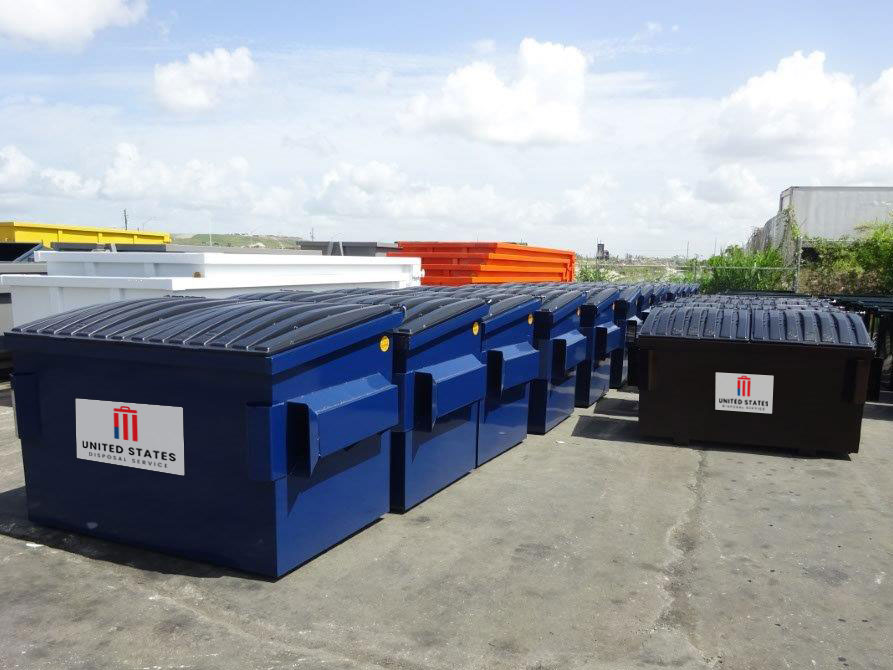
The company’s front-load lineup is four sizes: 2, 4, 6 and 8 yards, with no off-menu sizes. The 2-yard sits at the bottom of that lineup. The Commercial Dumpster Rentals page describes it as the container for a small restaurant or a company with only a handful of people on staff, and the industry pages give more detail:
- A café, a small bar with a limited kitchen or a takeout window often starts with a 2-yard (Restaurant Dumpster Service).
- A small professional office may be fine with a 2-yard or 4-yard on the weekly service that is already included (Office Dumpster Service).
- A small boutique or a service shop with light traffic may be comfortable with a smaller box (Retail and Strip Center Dumpster Service).
Headcount is only a starting point. It is more useful to know how often your current container is already full and whether the load is mostly dry cardboard, wet food waste or a mix. A florist that breaks down a few boxes a day and a kolache shop with wet waste every morning can have the same staff size and very different needs.
Why Houston businesses need their own hauler
The City of Houston Solid Waste Management Department’s residential garbage page says the City’s weekly curbside cart service is for residential homes, and that apartment complexes and businesses receive private collection services. The City’s long-range solid waste plan quotes the duty in Chapter 39 of the City Code: property owners must make sure solid waste is collected on a regular schedule, at least once a week or more often if required. A 2-yard on weekly service is the smallest setup that meets that baseline with a front-load container.
What is included with the rental
The container comes with a lid, which helps keep out rain, animals and odor. In a city with Houston’s summer heat and sudden downpours, a closed lid matters for a small box that may sit a full week between pickups. Every commercial dumpster rental includes weekly collection. If the box fills faster, pickup can go to two, three or four days a week, and daily collection is available. Frequency can also be reduced for a seasonal slowdown, with billing updated to match. On a permanent account the container stays on the property, and when the truck services it the trash is removed and the unit is cleaned.
A second container used only for recyclable material can be added, so cardboard does not use up the space in a small trash box. What local outlets accept varies, so the team confirms it when quoting rather than publishing a checklist. See Commercial Recycling.
When a 2-yard is too small
If the lid will not close by pickup day, there are two fixes: more pickups on the same 2-yard, or the next size up, the 4-yard. The Property Manager page makes the point that a container emptied too seldom will smell and overflow regardless of its size, so for food waste in hot weather, a second weekly pickup is often the better answer. Changes are made by contacting the company.
Pad, enclosure and truck access
A front-load truck comes at the box from the front, engages it, raises it and sets it back in the same spot. Pad layout, the truck’s approach, overhead clearance, enclosure width and gate access all matter, and the team asks about them when quoting. Small Houston businesses often share a strip-center enclosure or sit on tight lots off a busy road, so note any low canopy, drive-through lane or locked gate when you call. There is no published rate. Pricing is quoted for the address, the container and the pickup schedule.
Houston rules that affect commercial dumpster service
Houston does not run commercial trash collection itself, but it does regulate the companies that do. These are the points a small business owner should understand before ordering a 2-yard.
Is your “Houston” address inside the city?
The City’s Commercial Solid Waste Operator Franchise FAQ warns that many addresses listed as “Houston” are not inside City boundaries. It points to the City’s map viewer to check. According to the FAQ, a property in the FULL City Service Type area is subject to the 4% franchise fee and the 1% City sales tax; a property in a LIMITED purpose annexation area is not subject to the franchise fee but is charged the 1% sales tax for that district; and a property in the ETJ (extraterritorial jurisdiction) pays neither. For sales tax questions on hauling services, the FAQ sends readers to the Texas Comptroller.
The commercial solid waste franchise
The City’s Solid Waste Franchises page says Article VII of Chapter 39 makes it unlawful for a commercial solid waste operator to collect, haul or transport solid or industrial waste from commercial properties in the city without a franchise approved by City Council. The City’s franchise definitions name front-load dumpster trucks as one of the vehicles covered, and define commercial properties as land used for commercial and industrial purposes, excluding apartment and condominium complexes and single-family homes. Franchisees must display the City franchise decal on both sides of the truck, per the FAQ.
The practical takeaway for you: the franchise belongs to the hauler, not the customer. Before service starts at an address inside the city, ask who will empty the container and confirm that company is franchised. The team tells you who services your address when it quotes.
The 4% franchise fee on your invoice
The franchise FAQ says franchisees remit 4% of applicable gross revenue to the City, including pickup charges, container rental and fuel surcharges. A hauler may pass that cost on, but Section 39-116, as quoted in the FAQ, requires it to appear as a separate line item on the invoice. The FAQ also says the fee applies to service at churches and other tax-exempt groups, schools and other government agencies, and assisted living centers; only revenue from residential properties and from the City of Houston itself is exempt. So if you see a franchise fee line on a Houston dumpster bill, that is the reason. The City’s long-range plan adds that haulers also secure annual dumpster permits that vary with container size.
Recycling and the franchise
According to the same FAQ, recycled material is by definition not solid waste and is not subject to the franchise fee, although the City recommends that recycling haulers be franchised anyway. For a small business with a 2-yard trash box and a separate cardboard container, ask how each service will appear on the invoice.
Restaurants: keep grease out of the dumpster
Many 2-yard customers are small kitchens, and Houston has firm rules on grease. The Houston Health Department’s Waste Generator FAQ says used fryer grease must be picked up by a private disposal company and may not be poured down the drain, into a grease trap, a ditch or a storm drain. It can be stored in a rendering bin or a lidded container until pickup. The Department’s Special Waste Generators page says Section 47-512(b) of the City Code requires every grease interceptor inside the city limits to be fully pumped at least every 90 days unless a waiver is approved, and the Houston Permitting Center lists the documents an inspector will ask for, including five years of waste manifests. None of this is front-load dumpster service, but it shapes the setup: keep the rendering bin and the trash box apart, and keep liquids out of the 2-yard.
Working with brokers, property managers and multi-site accounts
United States Disposal Service works well with brokers. Its Service Brokers page describes a team dedicated to broker relations that handles account questions, scheduled services, service plan management and pricing. A small franchise owner with stores in Houston and other cities can put several locations on one account; see Nationwide Accounts.
How to request a 2-yard front-load dumpster in Houston
United States Disposal Service is headquartered at 16150 N. Main St., Jacksonville, Florida. It arranges commercial service nationwide from that office, working with trusted local contractors who run the trucks. This post does not claim a Houston or Texas office, a City of Houston franchise or any exclusive hauling rights. For a 2-yard container, a recycling container or a broker account, contact John:
- Email: [email protected]
- Phone: 904-305-7534
Have the service address ready (and whether the map viewer shows it inside the city), along with the type of business, what goes in the box, how often your current container fills, whether you already have recycling service and where the new container will sit. You can also start a request on the Order Now page. This post does not promise a price, a start date or a specific pickup day.
Frequently asked questions
1. Who is a 2-yard front-load dumpster for?
The company describes the 2-yard as its smallest front-load container, for a small restaurant or a business with only a handful of people on staff. Typical examples on its industry pages include cafés, small bars with limited kitchens, takeout windows, small professional offices and light-traffic shops.
2. What comes with a 2-yard rental?
A lidded container, with trash and recycling collection included in the rental agreement and weekly pickup as the baseline. A separate recycling container can be added. When the truck services a permanent container, it is emptied and cleaned. Pricing is quoted per property.
3. Will the City of Houston pick up my business trash?
No. The City’s residential garbage page says curbside service is for residential homes and that apartment complexes and businesses receive private collection.
4. Does a hauler need a franchise to serve my Houston business?
Inside the city limits, yes. The City’s Solid Waste Franchises page says a commercial solid waste operator may not collect from commercial properties in the city without a City Council-approved franchise. Ask who will service your address and confirm they are franchised.
5. Why is there a franchise fee line on my bill?
Franchised haulers pay the City 4% of applicable gross revenue, and if they pass it on, the City Code requires it as a separate invoice line, according to the City’s franchise FAQ. Properties in limited purpose annexation areas or the ETJ are not subject to the fee.
6. How do I know if my address is inside the City of Houston?
Check the City’s map viewer. The franchise FAQ notes that many “Houston” mailing addresses are outside City boundaries.
7. Can I put used fryer oil in the dumpster?
No. The Houston Health Department says used fryer grease must be picked up by a private disposal company and stored in a rendering bin or a lidded container until then. Grease interceptors inside the city must be pumped at least every 90 days unless a waiver is approved.
8. What if my 2-yard keeps overflowing?
Add pickups (two, three or four days a week, or daily), add a recycling container for cardboard, or move up to the 4-yard. Call to make the change, and billing is updated.
9. How do I get a quote for a 2-yard front-load dumpster in Houston?
Email [email protected] or call 904-305-7534 with the service address, business type, what you throw away, how often your current container fills, your current recycling setup and where the box will sit. You can also start at Order Now.
Follow United States Disposal Service on LinkedIn for service updates, and see more posts in the Newsroom.