
United States Disposal Service provides 8-yard front-load dumpster service for Illinois businesses whose trash has outgrown a smaller box: the distribution building off I-55 or I-80, the grocery store anchoring a strip center in the suburbs, the hospital-area office park, the school district, the busy restaurant in Peoria or Rockford. The 8-yard is the largest front-load container the company lists. Trash collection and recycling collection are both included in the rental agreement, weekly pickup is the starting point, and every account is quoted for its own address. This guide is about the statewide side of Illinois: what state law keeps out of the dumpster, how county waste plans and city hauler licenses work, and the health and fire rules that decide where an 8-yard can sit. For the City of Chicago’s own rules, see our Chicago 8-yard guide.
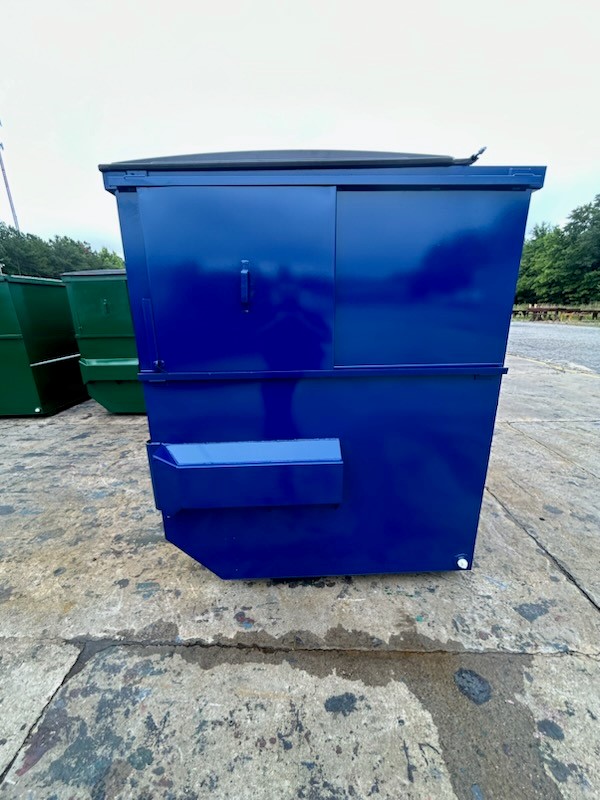
What an 8-yard front-load dumpster is and who uses one
The company’s front-load lineup is four sizes: 2, 4, 6 and 8 yards, with no off-menu sizes. The 8-yard is the top of that lineup, for a business whose waste stream will not fit the smaller boxes. The front-load truck approaches the container from the front, engages it with its forks, lifts it and sets it back in the same spot, so the pad layout, the approach, overhead clearance, enclosure width and gate access all matter, and the team asks about them when quoting. The company’s industry pages name the kinds of sites where an 8-yard usually comes up:
- A warehouse or light industrial building that breaks down pallets of cartons every day (Warehouse and Light Industrial Dumpster Service).
- A grocer, a big-box store or a strip center where several tenants share one enclosure (Retail and Strip Center Dumpster Service).
- A high-volume kitchen, banquet hall or restaurant that tops off a 6-yard between pickups (Restaurant Dumpster Service).
- An apartment complex, condominium or HOA with a central enclosure (Home Owners Associations and Property Manager Dumpster Service).
- A school campus or a large church with a fellowship hall and events (Church and School Dumpster Service).
Headcount is only a starting point. It is more useful to know how often your current container is already full and whether the load is mostly dry cardboard, wet food waste or a mix. A Joliet distribution center and an Elgin banquet hall can both need an 8-yard for very different reasons.
What is included with the rental
The container comes with a lid, which helps keep rain, animals and odor in check. Every commercial dumpster rental includes weekly collection. If the box fills faster, pickup can go to two, three or four days a week, and daily collection is available. Frequency can also be reduced for a seasonal slowdown, such as a school over the summer, with billing updated to match. On a permanent account the container stays on the property, and when the truck services it the trash is removed and the unit is cleaned. A second container used only for recyclable material can be added so cardboard does not use up space in the trash box (Commercial Recycling).
When an 8-yard is not enough
Because the 8-yard is the largest front-load size, the next steps after it are more pickups, a second container for recycling, or a second trash container. For wet waste in high volume, ask about the 35-yard self-contained compactor. For food waste, a second weekly pickup is often better than more container space, because a full box emptied too seldom still smells and draws pests. Going the other way, a business that never fills its 8-yard can step down to a 6-yard. Changes are made by contacting the company.
What Illinois law keeps out of the dumpster
Illinois has several statewide landfill bans written into its statutes. They apply to businesses as much as households, and an 8-yard is big enough that someone will eventually try to put one of these items in it. Post the list near the enclosure and tell your crew.
Landscape waste
Under 415 ILCS 5/22.22, no one may knowingly mix landscape waste intended for collection or landfill disposal with other municipal waste, or put it in a container headed for a landfill unless the container is biodegradable. Grass clippings, leaves and brush from an office campus, an HOA common area or a church lawn need their own collection, not the trash box.
Car batteries
415 ILCS 5/22.23 bans placing a lead-acid battery in any container intended for collection and disposal at a municipal waste landfill. Since January 1, 2020, a lead-acid battery may not go in a recycling container collected by a hauler either. Retailers that sell these batteries must take used ones back. An auto shop or fleet yard should keep them out of both containers (see Auto Shop Dumpster Service).
Tires
415 ILCS 5/55 says no one may knowingly mix used or waste tires, whole or cut, with municipal waste, and bars sanitary landfills from accepting them for final disposal except under narrow, permitted exceptions. Tires go to a tire collector, not the front-load box.
Electronics
The Consumer Electronics Recycling Act bans covered electronics from Illinois landfills (415 ILCS 151/1-83). The Illinois EPA’s electronics recycling FAQ says the ban applies to households, businesses, schools and government agencies, and lists the covered devices, including computers and tablets, monitors, printers, scanners, televisions, keyboards and mice, fax machines, small-scale servers and home audio components. An office refresh or school tech cleanout needs an electronics recycler, not the dumpster.
County waste plans and recycling programs
Illinois runs municipal waste planning through its counties. The Solid Waste Planning and Recycling Act requires each county to adopt a plan for managing municipal waste generated within its boundaries (415 ILCS 15/4), and each plan must include a countywide recycling program designed to recycle 25 percent of the county’s municipal waste, subject to viable markets (415 ILCS 15/6). The same section lets a county make special provision for commercial and institutional establishments that run their own recycling programs, provided they give the county written documentation of the tons recycled each year. If your county asks, your hauler’s service records are where those numbers come from.
In suburban Cook County, the County’s Solid Waste and Recycling Ordinance has waste haulers file quarterly reports with the Department of Environment and Sustainability, and the County lists separate hauler and non-residential hauler report deadlines (Cook County Solid Waste and Recycling Permitting). That reporting is the hauler’s job, but it is one more reason to run cardboard and other accepted material in its own container.
City hauler licenses outside Chicago
Many Illinois cities and villages decide who may haul trash inside their limits. Two examples:
- Naperville issues a Scavenger License and publishes the list of companies currently licensed to serve as scavengers in the city.
- Springfield’s code defines a refuse hauler as a person licensed by the City under Chapter 110 who collects garbage, solid waste, rubbish, recyclables or yard waste for consideration (Springfield Code, Chapter 105).
Some suburbs also contract with a single hauler for residential service, and a few extend those contracts to some commercial properties. Before you sign up, ask your city or village whether it requires a licensed or franchised hauler, a recycling plan or an enclosure standard for businesses. United States Disposal Service arranges service through trusted local contractors who run the trucks, and the team checks local requirements when quoting.
Health and fire rules that decide where the box sits
Restaurants and food stores: the Illinois Food Code
The Illinois Department of Public Health’s Food Code (77 Ill. Adm. Code 750) incorporates the FDA 2022 Food Code, including Chapter 5 on water, plumbing and waste, and applies to all food establishments. Under that chapter, outdoor refuse and recycling receptacles need tight-fitting lids, doors or covers, and the storage area must be kept clean. Your local health department enforces it, so a closed lid and a clean pad matter on inspection day.
Fire code clearance
Fire prevention codes in Illinois are adopted locally, and many communities use an edition of the International Fire Code. Its dumpster rule keeps containers of 1.5 cubic yards or more out of buildings and at least 5 feet from combustible walls, openings and combustible roof eave lines, with exceptions such as sprinkler-protected areas. An 8-yard is far over that threshold. Ask your local fire department which edition and amendments apply before you choose a spot against a wood-framed wall or under an eave.
Measure the pad first
An 8-yard is the biggest front-load box on the menu, and the truck needs a straight approach to line up its forks. Check the enclosure width, gate swing, overhead wires or canopies, and whether snow piles will block the approach in a northern Illinois winter. A side loading door like the one pictured above can help when staff load from a dock.
Working with brokers, property managers and multi-site accounts
United States Disposal Service works well with brokers. Its Service Brokers page describes a team dedicated to broker relations that handles account questions, scheduled services, service plan management and pricing. A chain with stores in Aurora, Champaign and the Metro East, or a property manager with buildings in several counties, can put the locations on one account; see Nationwide Accounts.
How to request an 8-yard front-load dumpster in Illinois
United States Disposal Service is headquartered at 16150 N. Main St., Jacksonville, Florida. It arranges commercial service nationwide from that office, working with trusted local contractors who run the trucks. This post does not claim an Illinois office or any Illinois EPA, county or municipal license, permit, franchise or contract for United States Disposal Service. For an 8-yard container, a recycling container or a broker account, contact John:
- Email: [email protected]
- Phone: 904-305-7534
Have the service address ready, along with the type of business, what goes in the box, how often your current container fills, whether you already have recycling service, and where the new container will sit. You can also start a request on the Order Now page. There is no published rate, and this post does not promise a price, a start date or a specific pickup day.
Frequently asked questions
1. Who is an 8-yard front-load dumpster for?
Businesses whose trash will not fit the smaller boxes: warehouses, grocers, big-box and strip-center tenants, high-volume kitchens, apartment and HOA enclosures, and school or church campuses. How fast your current box fills matters more than headcount.
2. What comes with an 8-yard rental?
A lidded container, with trash and recycling collection included in the rental agreement and weekly pickup as the baseline. A separate recycling container can be added. When the truck services a permanent container, it is emptied and cleaned. Pricing is quoted per property.
3. Can I put grass clippings and leaves in the dumpster in Illinois?
No. 415 ILCS 5/22.22 bars mixing landscape waste with other municipal waste headed for a landfill, or putting it in a landfill-bound container unless the container is biodegradable.
4. Can old computers or TVs go in a business dumpster?
No. Illinois bans covered electronics from landfills under 415 ILCS 151/1-83, and the Illinois EPA says the ban applies to businesses, schools and government agencies, not just households.
5. What about tires and car batteries?
Both are banned from the trash. Tires may not be mixed with municipal waste (415 ILCS 5/55), and lead-acid batteries may not go in a landfill-bound container or, since 2020, in a hauler’s recycling container (415 ILCS 5/22.23).
6. Does my city require a licensed hauler?
Many do. Naperville licenses scavengers and Springfield licenses refuse haulers, for example. Ask your city or village before you sign up; the team checks local requirements when quoting.
7. How close to the building can an 8-yard sit?
Where the International Fire Code applies, containers of 1.5 cubic yards or more generally must be at least 5 feet from combustible walls, openings and roof eave lines unless an exception such as sprinkler protection applies. Your local fire department has the final word.
8. What if my 8-yard keeps overflowing?
Add pickups (two, three or four days a week, or daily), add a recycling container for cardboard, or add a second trash container. For heavy wet waste, ask about the 35-yard self-contained compactor.
9. How do I get a quote for an 8-yard front-load dumpster in Illinois?
Email [email protected] or call 904-305-7534 with the service address, business type, what you throw away, how often your current container fills, your recycling setup and where the box will sit. You can also start at Order Now.
Follow United States Disposal Service on LinkedIn for service updates, and see more posts in the Newsroom.